
Custom Brass Jewelry: Materials, Plating and Minimums
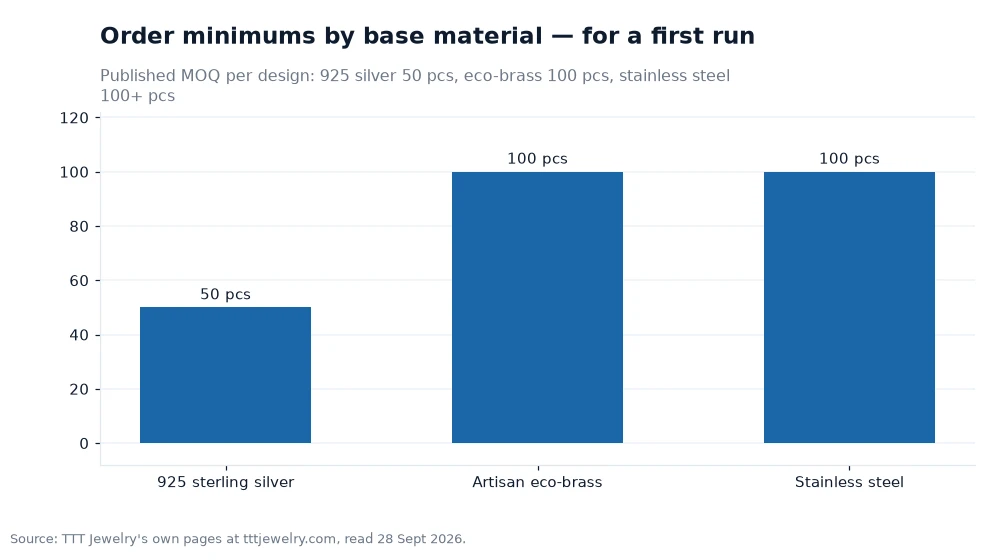
Brass is the material a buyer picks when shape and finish matter more than gram weight, and the published terms reflect that: artisan eco-brass runs at 100 pieces per design, twice the 50-piece 925 sterling silver threshold, with multi-layer gold or rhodium plating and an anti-tarnish e-coating. Three specifications decide whether the order ages well — the alloy, the coating stack and the findings.

Key takeaways
- Artisan eco-brass starts at 100 pieces per design; 925 sterling silver starts at 50, so brass is a 2× commitment per design.
- Brass finishes are multi-layer 14K, 18K or 24K gold, rhodium, and an anti-tarnish e-coating.
- Plating is published as 100% compliant with REACH and CA Prop 65, free of lead, cadmium and nickel.
- CAD lands inside 48 hours and the master sample in 25–30 days, before a 3–4 week bulk run.
The coating carries the perceived value
Brass is a copper-zinc alloy, and a bare brass surface reacts with air, moisture and skin. The published brass line is artisan eco-brass, finished rather than left raw: multi-layer 14K, 18K or 24K gold, rhodium, or an anti-tarnish e-coating. Those are not interchangeable decorations. They are the wear layer, and they set the colour a customer sees in the first ten seconds.
The e-coating deserves separate attention because buyers often treat it as an optional extra. On brass it is a barrier between the alloy and the outside world, applied after plating to slow tarnish and reduce direct metal-to-skin contact. A brass earring with gold plating and no barrier behaves differently over a season than one with both, even when the two look identical on the approval table.
Compliance sits on top of that. The published position is REACH compliance, with plating 100% compliant with REACH and CA Prop 65 and free of lead, cadmium and nickel. For a buyer selling into the EU or California, that sentence belongs in the spec sheet rather than in a conversation, because it is the line a retailer's compliance team will ask for first.
Reading a brass specification sheet
A brass spec sheet is short if it is written properly. It names the alloy, the coating sequence, the findings, the stone or pearl content, the mark and the packing. The table below places the three published base materials side by side on the two numbers that shape a first order.
| Base material | MOQ per design | Published finish route | Where it fits |
|---|---|---|---|
| 925 sterling silver | 50 pieces | Multi-layer gold or rhodium, anti-tarnish e-coating | Higher perceived value, smaller runs |
| Artisan eco-brass | 100 pieces | Multi-layer 14K/18K/24K gold or rhodium, e-coating | Statement shapes and seasonal colour |
| Stainless steel | 100+ pieces | PVD vacuum plating | Waterproof daily-wear lines |
Chain and finding choices belong on the same sheet, because they change the area that gets coated. A lobster clasp and an extender add plated surfaces that a plain hook does not, and each is a small part that can fail inspection on its own. A buyer who specifies the finding by type, length and finish gives the plating line a defined target; a buyer who leaves it open gets whatever the bench has in stock that week.
The third column is where most of the confusion lives. Gold plating on brass is an electrochemical deposit built up in layers; PVD on stainless is a vacuum process that bonds a thin film to the substrate. They are not substitutes, and a collection that mixes both will need two approval standards, not one. A spec sheet that names only the metal, without the finish route beside it, leaves the buyer comparing two different processes as though they were one.
What the 100-piece minimum actually buys
The threshold is per design, not per order, and that distinction changes how a range is planned. Four brass designs commit 4 × 100 = 400 pieces. A five-size curve splits each design into 100/5 = 20 pieces per size. Add four finishes and the same 100 pieces become 100/(5 × 4) = 5 pieces per size per finish, which is thin for a retail wall.
This is why finish count is a minimum-order decision rather than a styling decision. A buyer who wants one shape in gold, silver-tone and rose-tone is effectively buying three designs from the tooling side, even though the mould is shared. The mould is the reusable element; the plating runs are what multiply.
When a brief is still at the sketch stage, the quickest way to scope the commitment is to ask a custom brass jewelry manufacturer what the 100 pieces cover — one finish or the full colour range — before the design is locked. The answer usually reshapes the range plan more than any drawing revision.
Sampling sequence and where it stalls
The published sequence is CAD in under 48 hours, a physical master in 25–30 days, then 3–4 weeks of bulk. For brass, the approval that stalls is rarely geometry. It is colour. A gold tone judged on a flat coupon can read warmer or cooler once it wraps a curved surface, and a rhodium finish judges differently under a shop light than under a bench lamp.
Two habits reduce that risk. First, approve the coating on the actual geometry, not on a flat strip. Second, approve it under the light the customer will see it in, which for most brands means retail lighting rather than a workshop tube. Neither habit shortens the 25–30 day window; both prevent a second pass through it.
Buyers who need the concept developed rather than executed can bring the brief to an OEM/ODM jewelry manufacturer, where the same sampling clock applies but the design work sits with the factory. The distinction is who resolves the ambiguity, not how long the metal takes.
Worked example
Take a four-design brass collection on a five-size curve. The per-design minimum gives 4 × 100 = 400 pieces. Divided across five sizes, that is 400/5 = 80 pieces per size across the range, or 20 per size per design.
Compare the same range in silver. Four designs at the 50-piece threshold is 4 × 50 = 200 pieces, exactly half the brass commitment, because 50/100 = 50%. The shapes can be identical and the calendar identical; only the inventory exposure changes.
Now put the calendar alongside. At the fast end, 2 days of CAD + 25 days of sampling + 21 days of bulk = 48 days. At the slow end, 2 + 30 + 28 = 60 days. Expressed as weeks, that is 48/7 = 6.9 and 60/7 = 8.6, so a brass collection briefed today lands in roughly seven to nine weeks, assuming the coating is approved on the first master.
Frequently asked questions
What is the MOQ for custom brass jewelry?
Artisan eco-brass runs at 100 pieces per design, against 50 pieces for 925 sterling silver and 100+ pieces for stainless steel.
Does brass jewelry need an anti-tarnish coating?
For wear, yes: the published brass finish pairs multi-layer gold or rhodium plating with an anti-tarnish e-coating that limits tarnish and direct skin contact.
Is brass plating compliant with EU rules?
The published position is REACH compliance, with plating 100% compliant with REACH and CA Prop 65 and free of lead, cadmium and nickel.
Specifying a first brass run
Write the spec in the order the bench reads it: alloy, coating, findings, stones, mark, packing, with a photo of the approved colour beside the approved geometry. Keep the first run narrow — one or two shapes, one finish family, a full size curve — and plan the repeat order on the pieces that sell. If the same silhouette is later needed in a higher-value metal, the 50-piece threshold on the sterling silver jewelry manufacturer page is the number to plan against. Confirm what the 100 pieces include, because packaging, hallmarks and barcode labels are easier to fold into the first sample than to add after bulk approval.
Source note: figures come from the manufacturer's own website (tttjewelry.com), read 28 Sept 2026.[1]